
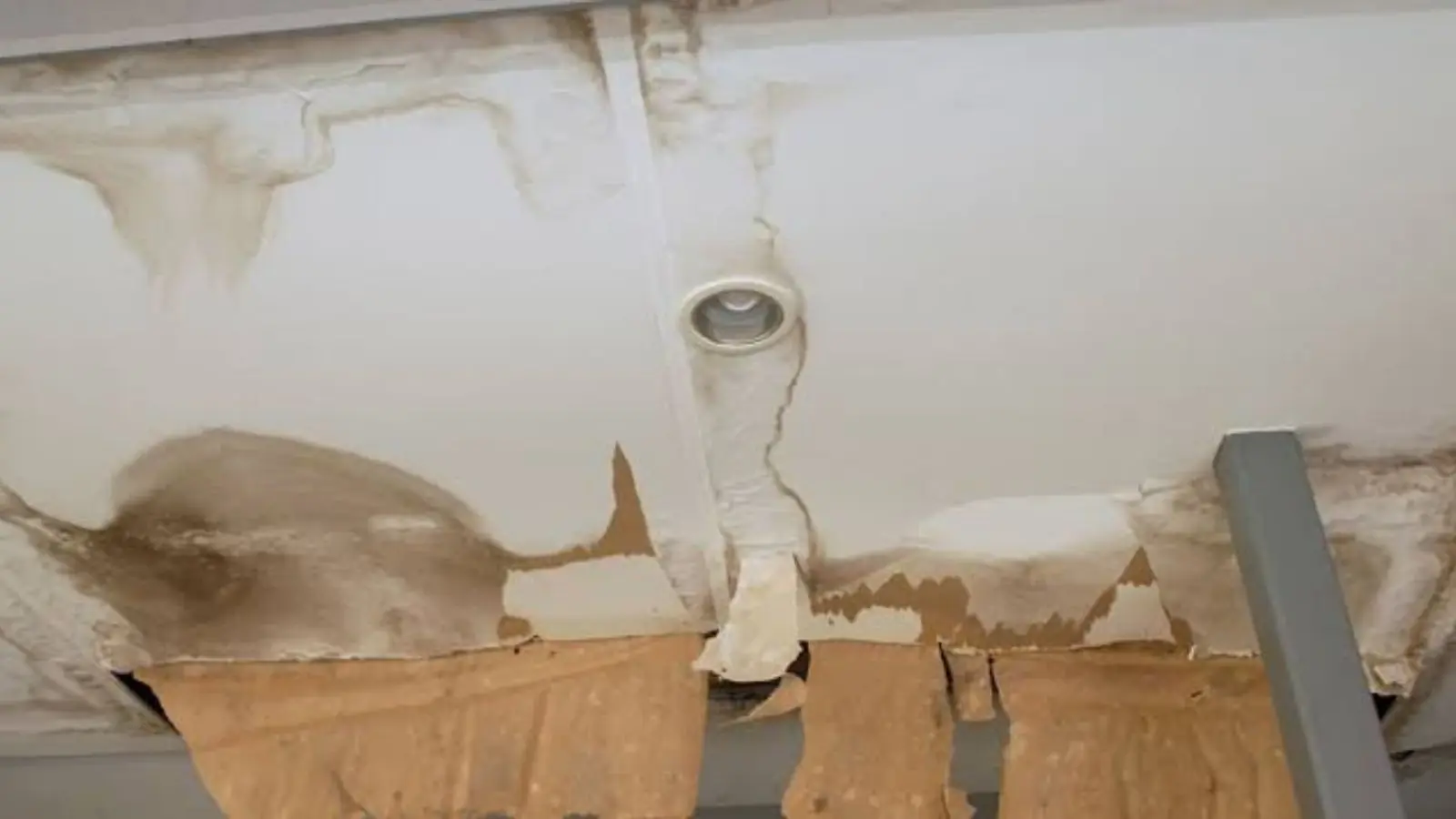
Sheetrock water damage in a Lynnwood, WA home usually starts with a stain, a soft spot or a bubble in the paint. The big question is whether the board can dry where it hangs or has to come out.
The answer depends on how long it stayed wet, what kind of water touched it, and what is behind it. This post lays out the decision, the cutting, and the patching stages in order.
The quick test: dry it in place or cut it out
Gypsum board is a paper-faced gypsum core. It tolerates a short soaking, then softens and loses strength as the paper and core stay wet. A moisture meter, not your thumb, tells the crew how far the water went.
Use the table as a starting point. The final call belongs to the person holding the meter.
| What you see | Usual call | Why |
|---|---|---|
| Light stain, board firm, dried within a day or two | Dry in place, then prime and paint | Paper and core are intact and nothing is growing. |
| Bubbling or sagging paint, board still firm | Often dried in place with air movers | Moisture sits in the paint layer, but readings must confirm it. |
| Soft, crumbly or sagging board | Cut out and replace | The core has lost strength and will not hold screws or compound. |
| Board wet for more than a couple of days | Usually cut out | Paper and compound become a food source if mold gets started. |
| Any board touched by sewage or dirty flood water | Cut out and dispose | Porous material in Category 3 water is not kept. |
| Wet board over wiring or a ceiling that bulges | Call a pro first | Electrical and falling-material risks come before repairs. |
Mark any stain edge with a pencil and a date. If the line grows overnight, water is still arriving from somewhere, and the source needs a plumber or roofer before any drywall work makes sense.
Why drying comes before any patching
A patch over wet board fails slowly. Compound will not bond to damp paper, new paint blisters, and the studs behind it stay wet where nobody looks. Mold needs moisture, so a damp cavity closed up with fresh board is the worst outcome.
Drying means air movers to push dry air across the surface, LGR dehumidifiers to pull moisture from the room, and meter readings taken each day. Readings from the damaged wall are compared with a wall nearby that never got wet, which gives a dry standard for your house.
Drying in place can take three to five days for a wall that stayed wet briefly. The patch work starts only after the meters agree. Our water damage repair page covers how the rebuild phase fits after drying.
Water still spreading? The emergency line is open around the clock.
☎ Call (425) 592-3399What to do about the insulation behind the board
Insulation decides how large the cut-out gets. Clean, lightly wet fiberglass batts can sometimes be lifted, dried and reinstalled. Blown-in or dense-packed insulation holds water against the studs and is usually removed from the wet section.
Insulation touched by dirty water is discarded in every case. If the wall is an exterior wall, a crew will also check the sheathing behind the insulation, since a roof or siding leak can wet it from the outside.
Ask the crew to show you what they find behind the board before it is covered. A short walk-through and a few photos of the open cavity are a normal request.
How a cut-out is done
A clean cut makes the patch easier. Here is the usual sequence for a wet wall.
Mark the wet line
Meters find the highest point where board reads wet. The cut goes above that, often 12 to 24 inches above the highest wet reading for a floor-level leak.
Score and cut
A utility knife or oscillating tool scores the paper. The cut lands on the center of a stud where possible, so new board has something to screw into.
Remove and inspect
Removed board goes into bags. Crews look at the stud faces, the bottom plate and any wiring for staining, swelling or rot.
Dry the open cavity
An open wall dries much faster than a closed one. Air movers aim into the cavity until the studs read at the dry standard.
Replace the insulation
New insulation goes in only after the framing is dry. Closing a wall over damp wood is how mold gets a second chance.
Patching stages from raw board to paint
Half-inch board is common in houses, so match the thickness already on your wall. A thinner patch sits low and shows through the finish.
The usual order is hang, tape, three coats of joint compound, sand, prime and paint. Each coat of compound needs time to dry before the next, and each coat is feathered wider than the last so the patch fades into the old wall. A rushed finish shows up as a ridge in raking light.
- Hang the new board and screw it into studs, leaving the paper face intact.
- Embed paper or mesh tape in the first coat of compound over each seam.
- Apply a second and third coat, feathering each one wider.
- Sand lightly, wipe off the dust, and look at the wall with a lamp held low.
- Prime the whole repair with a stain-blocking primer, then paint.
Finishing: texture, color and the full-wall rule
Texture is where patches give themselves away. Orange peel, knockdown and skip trowel each need a different tool and mix, and a flat patch on a textured wall stays visible. Ask a finisher to match your texture on a scrap before they spray the real wall.
Paint color shifts with age and light. Painting the new patch alone leaves a visible square, so most painters take the coat to the nearest corner or break. Full-wall painting costs more in materials but hides the work.
Stain-blocking primer matters when the old stain was water-caused. Latex paint alone lets the stain bleed back, often within a few weeks.
Ceilings and upstairs leaks need their own plan
A leak from a bathroom or washer upstairs often wets the ceiling below first. A brown bulge in a ceiling can hold several gallons of water. Poking a small relief hole at the lowest point lets it drain into a bucket, but only if no light fixture or wiring sits nearby and you can stand clear of the area.
Ceiling board is heavier when wet and can drop without warning. If it sags in more than one spot, or covers a large area, stay out from under it and call a crew. The same caution applies to a house in Edmonds or Bothell, because a sagging ceiling is a falling-material risk anywhere.
After the ceiling dries, inspect the upstairs source too. A new patch below does nothing if the shower pan, supply line or drain upstairs still leaks.
When the safer call is a professional
Small spots on one wall with clean water are within reach of a careful homeowner. Larger work is not. Large areas, ceilings that sag, walls with outlets and switches inside the wet zone, and anything from a sewage backup should go to a crew.
Hanging and finishing board is also slower than it looks. Three coats with drying times between them is days of work, and a poor patch is a repaint away from showing up again. If the wall is tied to a wider water mitigation job, let the same crew handle drying first so the repair crew starts with dry framing.
Lynnwood note: older walls and the permit counter
The Census American Community Survey (2023 five-year estimates) puts the median year a Lynnwood home was built at 1979. Of about 17,600 housing units, the largest group, 4,038, was built in the 1960s, and roughly half were built before 1980.
Older walls often carry several layers of paint and older texture, so a clean match takes more effort. Ask the crew whether any material in your wall should be tested before it is cut, and expect more careful finishing than a newer home needs.
The City's Development & Business Services department reviews building plans and issues permits at the Permit Center at City Hall. For a small sheetrock patch, ask the city building department whether a permit is needed. For larger rebuild scopes, ask before work starts.
Questions we hear
Do I need a permit to replace sheetrock after a leak in Lynnwood?
The City's Development & Business Services department is the place to ask. Call or visit the Permit Center before work starts and describe the area and any wiring or plumbing involved.
Do not assume the answer from a neighbor's job. Ask the city building department whether a permit is needed for your specific repair.
Can I just paint over a water stain on drywall?
Only after the board is dry and the leak is fixed. Regular paint lets the brown stain bleed through, so use a stain-blocking primer first.
If the stain keeps returning, there is still moisture behind the wall, and painting only hides it.
How long does wet sheetrock take to dry?
A wall that stayed wet briefly often dries in three to five days with air movers and a dehumidifier. Thicker assemblies or insulated exterior walls can take longer. The meter decides, not the calendar.
Is bubbling drywall always ruined?
Not always. If the board is firm and readings come down, bubbling paint can sometimes be scraped and refinished. If the board feels soft or the bubble returns, replace that section.
Have a question the answers above did not cover? Call the line and ask.
☎ Call (425) 592-3399