
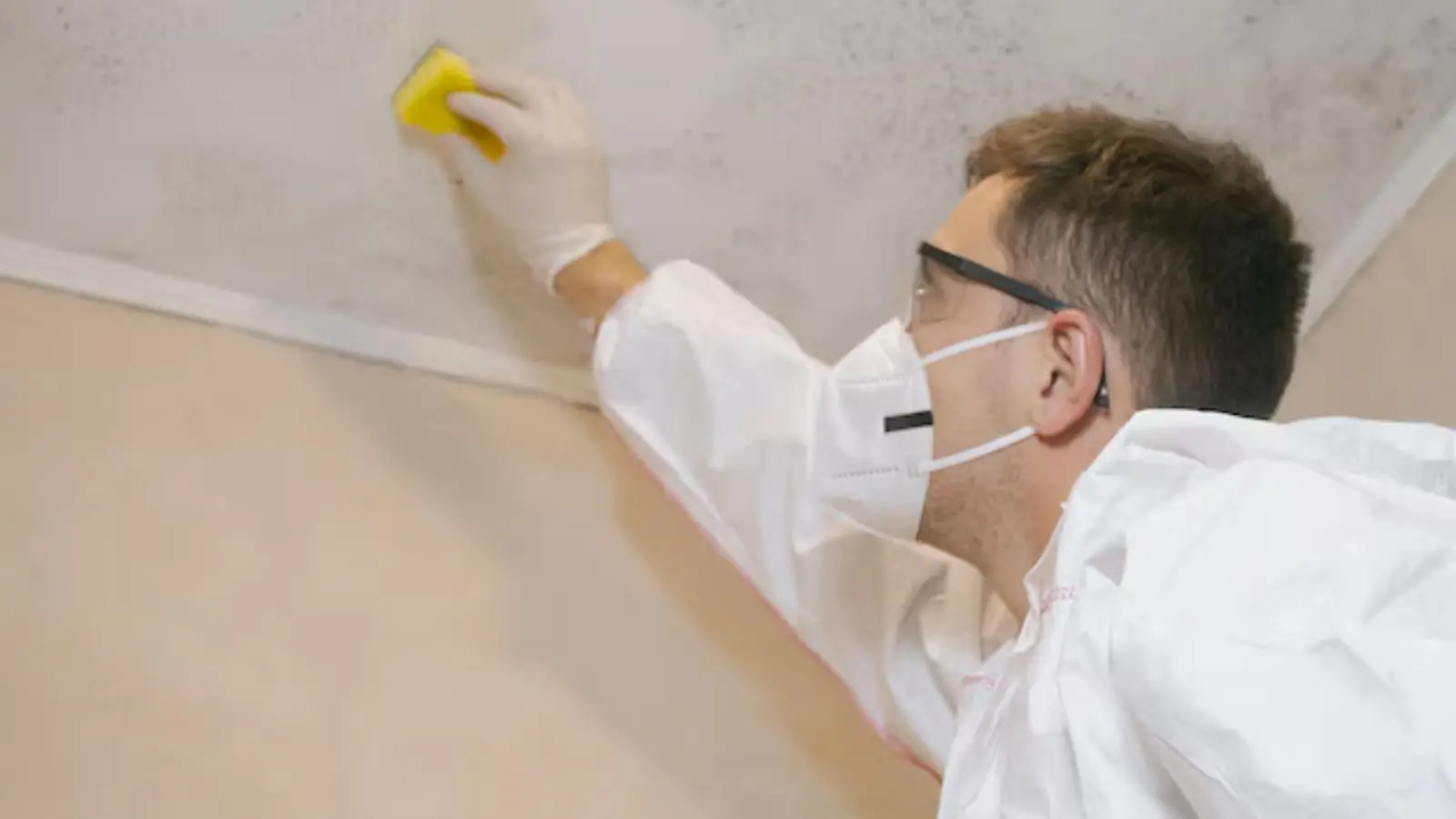
If you want to clean mold off a ceiling in Lynnwood, WA, the first question is what the ceiling is made of. A glazed tile edge or a sealed fixture can be wiped. Painted drywall cannot be cleaned the same way.
Below you will find a sorting guide, safe steps for a small hard surface, the myths that waste a weekend, and the signs that mean you should put the sponge down and call.
Sort your ceiling before you pick up a sponge
Ceiling materials fall into two groups. Non-porous surfaces, such as glass, glazed tile, sealed plastic and metal, do not absorb water. Porous surfaces, such as drywall, popcorn texture, acoustic tile and unsealed wood, soak up liquid and keep it.
Most Lynnwood bathroom and hallway ceilings are painted drywall. Paint slows absorption but does not stop it, and the paper face of the board underneath is a good place for growth to hold on. Cleaning the paint skin can leave the layer under it untouched.
Clean it yourself or call: a decision guide
| Situation | Reasonable for a homeowner? | Better handled by a crew |
|---|---|---|
| Small spot on glazed tile, glass or a sealed fixture | Yes, with detergent, water and protective gear | Only if it returns after the moisture is fixed |
| Spotting on painted drywall smaller than a sheet of printer paper | Possibly, but fix the moisture first and expect to monitor it | If it spreads, darkens again or the paper face feels soft |
| Larger area on drywall or textured ceiling | No | Yes, containment and removal under the S520 standard |
| Growth with an active leak or a stained, sagging ceiling | No | Yes, water drying first, then remediation |
| Growth near a bathroom fan duct or in an attic space | No | Yes, since the source may sit above the ceiling |
| Anyone in the house has breathing concerns | Ask a physician first | Yes, consider professional handling |
The table is a starting point, not a diagnosis. If you cannot tell which row you are in, treat the ceiling as the harder case and have it checked.
Safe steps for a small, hard, non-porous patch
Only use this routine on a surface that does not absorb water. Gather a bucket, dish soap, water, a soft brush, microfiber cloths, nitrile gloves, goggles, an N95-type mask and a plastic drop cloth.
Fix the water first
Stop the leak or run the fan so the surface stays dry. Cleaning a surface that keeps getting wet only buys a few weeks.
Protect the room
Lay the drop cloth, open a window if you can, and keep the bathroom door closed to the rest of the house. Dry brushing is out, since it throws growth into the air.
Wipe with a detergent solution
Use a damp, not dripping, cloth with a small amount of dish soap in water. Wipe in one direction, then rinse the cloth in a second bucket so you are not spreading material around.
Dry completely
Pat the area dry and run a fan on it for several hours. A surface that stays damp overnight invites the growth back.
Bag and wash up
Seal the cloths in a plastic bag before they leave the room, wash your hands and arms, and launder your clothes.
Water still spreading? The emergency line is open around the clock.
☎ Call (425) 592-3399The bleach myths that cost people a weekend
Bleach has a reputation as the answer to everything. On a hard, sealed surface it can lighten a stain, but it does nothing about the moisture that fed the growth. Lighter does not mean fixed.
On drywall it is worse. Bleach is mostly water, and water soaks into porous board while the chemical stays near the surface. The spot looks cleaner for a short time, the board gets wetter, and the problem is still there.
Never mix bleach with ammonia, vinegar or other cleaners. The combinations can release dangerous fumes. Pick one product, use it as the label directs, and keep the room ventilated.
Why a drywall ceiling is a different job
A porous ceiling cannot be reliably cleaned in place. Scrubbing grinds moisture and material deeper into the paper face, and the area you can see often understates what sits behind it. That is why crews typically cut out affected board and bag it rather than wipe it.
The work follows the ANSI/IICRC S520 standard for mold remediation, a published industry document that covers containment, air filtration and clearance steps. A crew seals the room with plastic, runs a HEPA air scrubber, removes the affected drywall and dries the framing. The page on mold remediation explains each step. If the ceiling also needs patching after the dry-out, water damage repair covers the rebuild.
Signs to stop and call
Put the sponge down if the ceiling feels soft, paint is peeling in sheets, the stain has a brown ring, the smell is musty even after cleaning, or the spot is back within a month. Each of these points to moisture that you have not yet found.
Call the 24/7 line, describe what you see, and a crew can map moisture with a meter and thermal imaging camera. Ask whether your state licenses mold work, and ask any company whether it follows S520. Health questions go to your physician.
Lynnwood note: use your water bill to hunt for a hidden leak
Two utilities handle water inside Lynnwood. The City's own utility billing page says the City bill covers water and sewer, and the City's 2012 water plan says the Alderwood Water & Wastewater District wholesales water to the City and also serves some addresses directly. Which one sends your bill depends on where you live, and the City offers a lookup map for checking whether an address is inside city limits.
If you suspect a slow leak above a bathroom, compare your last few bills. Then read the meter with every fixture off and see whether it still turns. A moving meter points to a leak somewhere. Use your own bill to see who serves you. If the stain is already spreading and you live in Bothell or Everett, the same 24/7 line covers those towns.
Questions we hear
Can I clean black spots off a painted ceiling with vinegar?
Vinegar is an acid cleaner, and it soaks into painted drywall like any liquid. It does not address the moisture that let the spots form.
On a small, sealed surface, a detergent wipe is simpler. On drywall, the safer step is to find the moisture first.
How big is too big for a DIY cleanup?
There is no single number that fits every house. A practical rule is to avoid cleaning any drywall patch larger than a sheet of printer paper, and any spot with a leak or soft board.
If you hesitate, call and describe it. A short call can save you a worse mistake.
Will painting over the spot with mildew-resistant paint work?
Specialty paint can resist new growth on a dry surface, but it does not dry out wet drywall or fix a leak. Paint over damp board and moisture can still collect behind the film.
Confirm dryness with a meter before any paint goes on.
Does the water meter trick work in a Lynnwood house on a shared line?
It works best for a single-family home with its own meter. If your building shares a line, ask the property manager or utility for a reading.
In either case, a stain overhead that keeps changing is a good reason to call.
Have a question the answers above did not cover? Call the line and ask.
☎ Call (425) 592-3399